
Dangerously Irrvelvant
Scott has worked with hundreds of schools, districts, universities, and other organizations and has received numerous awards for his technology leadership work, including the 2016 Award for Outstanding Leadership from the International Society for Technology in Education (ISTE). He is a frequent keynote speaker and workshop facilitator at regional, state, national, and international conferences. Scott also hosts two podcasts, LeaderTalk and Redesigning for Deeper Learning.
Harnessing New Technology for Deeper Learning
This book is aimed squarely at practitioners and their day-to-day instructional (re)design needs. We also explain in the book why we think the protocol is a great complement to SAMR, TPACK, RAT, PIC-RAT, and the Arizona and Florida Technology Integration Matrices. We include numerous tips and suggestions for using the four-shift protocol in your school(s)!
A Digital World is an Empowering One!
For so long the education system as been primarily factual recall. Low-level procedure knowledge. We are suffering from information overload. Low-level knowledge work is 80-85 percent of what students do and is not developing critical thinking, analyzing, doing, thinking, making, interacting, collaborating, communicating, and problem-solving. Working on real-world problems gives them self-direction, self-autonomy, and self-choice and empowers them. That can be more easily done with technology. When we give students the opportunity and tools to excel they will!
Most Recent Posts

Real Problems Versus Fake Problems
Robert Sternberg said: The characteristics of real-world problems are entirely different from the characteristics of problems on standardized tests. Standardized test problems are mostly multiple choice or short answer and have a right or wrong answer. Real...

Schools Can Feel Totalitarian to Some Students
I participated in a Twitter conversation yesterday that bounced around a bit. I believe that most of the folks I conversed with were from the United Kingdom. I also believe that many of them were in favor of what we might call ‘strict discipline’ in schools. One of...
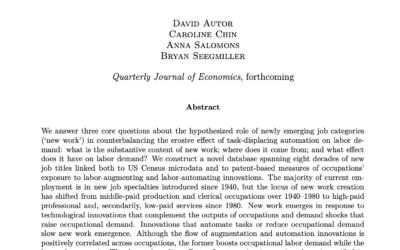
What are the new tasks, work, and jobs emerging?
Autor et al. defined new work as “the introduction of new job tasks or job categories requiring specialized human expertise” (p. 1). In other words, in which occupational sectors are new tasks, work, and jobs emerging/declining, and for whom? Here is an informative...
Podcasts
Check out our Latest Episode!
On LeaderTalk, I interview administrators who work hard to be a shining example of what it means to be a leader that students and teachers can aspire to be. We have an enriching conversation about how these administrators use their leadership to support students learning and creat healthy working environments for everyone involved!
Blog
“Our intelligence tends to produce technological and social change at a rate faster than our institutions and emotions can cope with. . . . We therefore find ourselves continually trying to accommodate new realities within inappropriate existing institutions, and trying to think about those new realities in traditional but sometimes dangerously irrelevant terms”-(War: The Lethal Custom, p. 441)
Learning and Teaching

Technology encourages us to learn new things and is a powerful tool in shaping exactly how our students should learn. We owe to them to adapt to the new Information Domain of our time. Here on my blog, I share what I have learned through the years about teaching, technology, students’ perspectives, teacher’s perspectives, and parent’s perspectives on the educational system. I’m here with some solutions!
News and Events

As someone who is constantly working towards the goal of making classrooms across the world more confident and aware of the amazing uses of technology, it is important that I keep you guys up to date on my speaking events and visits. Here on my blog, I share news about new podcast episodes, interviews, and accomplishments I have made along this journey with you all! There is also links to the souce matterial so you can enjoy yourself!
Leadership and Vision

One of the most important qualities for an educator at all levels is leadership, we need individuals that willing to actively adapt to the new information landscape and encourage the students that they have an opportunity to establish the skills needed to become leaders themselves. Here on my blog, I write about how leadership is essential to improving the current learning model in school and my vision of how we can use technology to achieve that.
Student Agency

Students are rarely given a choice in their own learning and that’s really a shame because when they do get an opportunity to do good things they do! It also gives them a genuine opportunity to enrich their own curiosity. Technology empowers everyone to have a voice. Here on my blog, I advocate for students to have a voice in their learning and explore their unique perspectives on what schools mean to them.
Contact Info
(707) 722-7853 (cell/office)
(303) 315-6311 (fax)
1234 Divi St. #1000, San Francisco, CA 94220
Join a community of individuals of people who like to think deeply, give students freedom, create technologicallly robust classrooms, and who genuinely want to prepare students as best as we professionals can.
School Improvement for 21st Century Skills, Global Citizenship,and Solutions for Creating the Learning Spaces Students Deserve
This short, actionable resource concisely explains the six key factors of school improvement in the 21st century: (1) information literacy, (2) the economy, (3) learning, (4) boredom, (5) innovation, and (6) equity. Quickly learn how schools are tackling these six areas head-on in order to help students grow into global citizens, critical thinkers, innovators, and literate content consumers.
The Four Shift Protoocal
Discover Our Solution!
Technology integration should be purposeful. That very simple statement is at the heart of the 4 Shifts Protocol. When we use digital technologies for learning and teaching, those uses should be intentional and targeted and not simply ‘tech for tech’s sake.’ We continually ask the question, ‘Technology for the purpose of what?’ With that in mind, we set out to create a template of questions that would allow educators to think critically – and purposefully – about their technology integration and other instructional (re)design goals.
- Learning Goals. Who selected what is being learned?
- Learning Activity. Who selected how it is being learned?
- Assessment of Learning. Who selected how students demonstrate their knowledge and skills and how that will be assessed?
- Work Time. During the lesson/unit, who is the primary driver of the work time?
- Technology Usage. Who is the primary user of the technology?